
Bergen County Projected vs Actual Release
A projected date is a calculated milestone. It is not a guaranteed appointment at a jail door. NJDOC uses the exact label Current Max Release Date for its most recent calculation after days earned off the sentence and days added for negative institutional conduct. The department warns that this field can differ at the end of each month.
The Current Parole Eligibility Date is a different field. It is the State Parole Board’s most recent expected date under its calculation policy. Eligibility begins consideration. It does not promise a grant. For a completed state-custody episode, Date Out-of-Custody confirms departure from NJDOC, but it still does not prove a return home. A detainer may move the person to another agency, and parole can continue after physical release.
A pretrial person at Bergen County Corrections and Rehabilitation Center often has no sentence-based projected date. Release depends on the court, processing, and any other hold. The distinction matters because a court order may precede physical discharge, while a transfer from BCCRC to NJDOC is not community release.
Find a Bergen County Projected Date
Start by separating county custody from state custody. NJDOC’s calculated fields apply to a person committed to state corrections. Bergen County’s jail materials do not expose an equivalent public formula or projected-date field. The court judgment and the correct agency record must be read together.
- Locate the authority. Determine whether the person is at BCCRC, in NJDOC, in federal custody, or under another agency.
- Obtain the judgment. Read the aggregate sentence, jail credits, consecutive or concurrent terms, and any mandatory minimum.
- Open the state record. Search the NJDOC Offender Search by SBI number when known, or by name with enough details to avoid a false match.
- Keep the date fields separate. Record Current Max Release Date and Current Parole Eligibility Date with the query date.
- Use Bergen records for a county term. Ask Jail Records and the court for the commitment, credits, and calculated release record.
- Recheck near the date. Look for new court action, disciplinary changes, a parole decision, or a hold.
- Confirm departure. Use Date Out-of-Custody, a VINE event, or the releasing agency’s actual record.
The broader Bergen County release-record search explains how to reconcile BCCRC, court, state, and federal custody events. It is especially useful when a blank county lookup may mean transfer instead of release.
Bergen County NJDOC Release Fields
The state Help inventory provides the terms needed to read a Bergen commitment accurately. County of Commitment identifies the venue of conviction and sentence, not present location. Current Facility is a location. Maximum Term reflects the sentence relationship and may be affected by court credits plus work, minimum-custody, and commutation credits.
| Field | What it means | What it does not prove |
|---|---|---|
| Current Max Release Date | Latest NJDOC calculation after earned and added days | A fixed community-release appointment |
| Current Parole Eligibility Date | Expected eligibility milestone under Board calculation policy | A parole grant or actual release |
| Date Out-of-Custody | Recorded departure from NJDOC custody | Freedom from every hold or supervision term |
| Current Facility | Location shown by NJDOC | The future supervising office |
| County of Commitment | County tied to conviction and sentence | Present jail or home county |
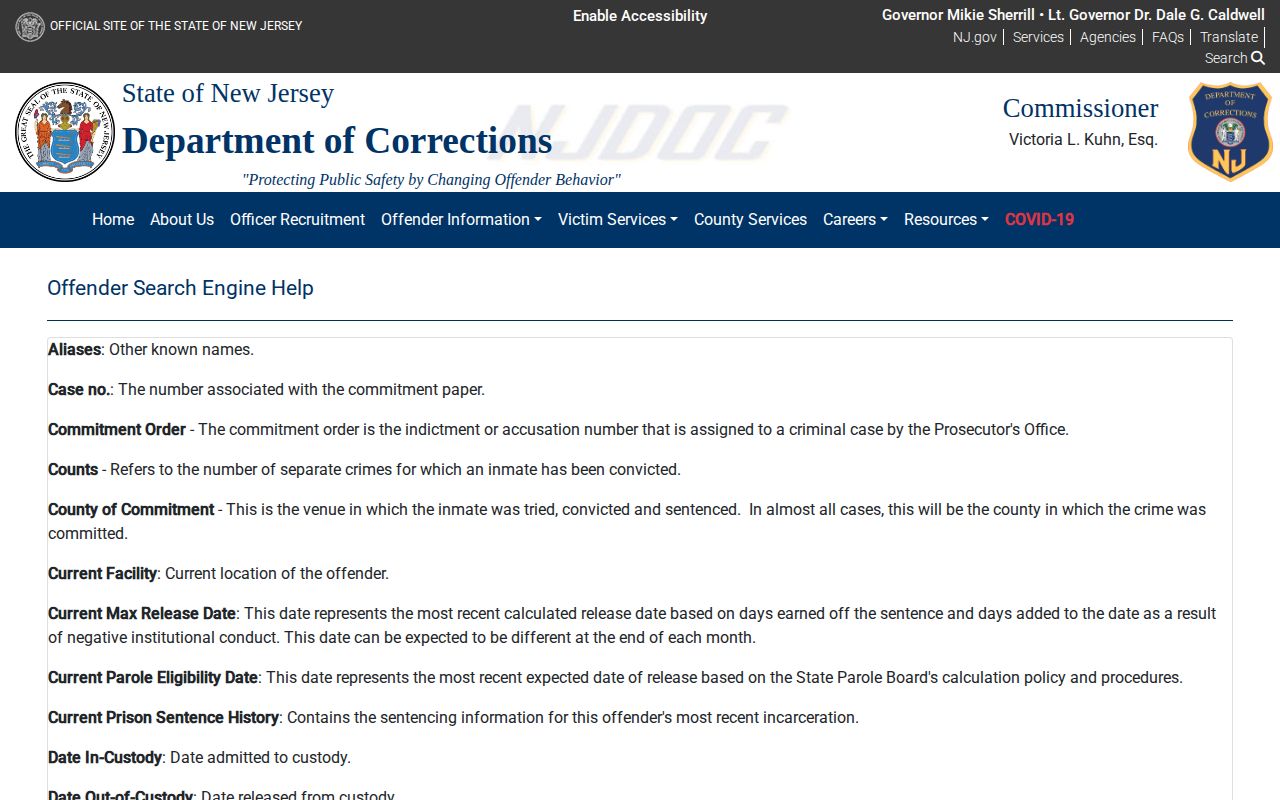
The NJDOC Help page gives the official release-date field definitions.
Bergen County Good-Time Calculations
NJDOC starts from the court’s aggregate sentence and custody credits, then administers credits permitted by law and rule. Public users should not reproduce the department’s result from a few visible numbers. Multiple commitments, concurrent or consecutive terms, amended orders, forfeitures, restorations, and entry timing can all affect the total.
New Jersey materials describe commutation credits, often called good time, which may be forfeited for misconduct. Work credit can apply to qualifying work, vocational assignments, or mandatory education at one day for each five days worked. Minimum-custody credit is described as three days per month for the first twelve months and five days per month after that. Approved program completion can also support special credit under the applicable rules.
N.J.S.A. 30:4-140 supports commutation credit, while N.J.S.A. 30:4-92 addresses work credit and N.J.S.A. 30:4-92a addresses discretionary education or workforce achievement credit. These credits do not cut through a judicial or statutory mandatory minimum. A period without qualifying work may not generate work credit.
Earn Your Way Out materials add a narrow program-credit layer. Qualifying completion of an approved program on or after January 20, 2020 can support special credit when the current aggregate maximum release date exceeds 210 days. The public record still does not expose every input needed to reproduce an official total. Eligibility for a program, actual completion, the date of credit, and the controlling term must all be confirmed by NJDOC.
Work credit is also tied to qualifying activity, not merely the passage of time. State materials identify periods that may not earn it, including voluntary nonwork, unavailable assignments, some medical lay-in, court remand, and disciplinary lockup. A public user should report the date NJDOC displays and the agency’s definition. It is unsafe to subtract a guessed block of days and publish a personal forecast.
Note: Verified county-jail work may support credit review, but NJDOC alone calculates the state record under the controlling sentence.
Bergen County NERA Release Limits
The No Early Release Act, N.J.S.A. 2C:43-7.2, creates an 85-percent parole-ineligibility minimum for enumerated first- and second-degree offenses. It does not mean every New Jersey incarcerated person serves 85 percent. The covered list includes specified homicide, assault, sexual, robbery, carjacking, arson, burglary, extortion, terrorism, and firearms offenses, including covered attempts or conspiracies.
The conviction date and current statutory text matter. For a covered first-degree offense, the law also provides a parole-supervision period of five years; for a covered second-degree offense, three years, subject to the statute’s interaction with other terms. Physical release can therefore start community supervision rather than close the sentence.
General primary eligibility under N.J.S.A. 30:4-123.51 usually follows the judicial or statutory minimum. If no minimum applies, the framework generally uses one-third of the term less qualifying credits. That is an eligibility calculation, not a promise that the Board will approve release.
A parole hearing adds its own sequence. An initial review and panel stage may produce a grant, denial, special conditions, or a Future Eligibility Term. Even after a grant, new information or an institutional infraction may cause rescission review. The release date should be checked again after each Board event and then confirmed in the custody record.
Why Bergen County Release Dates Change
A displayed date can move for lawful reasons in either direction. NJDOC warns that Current Max Release Date may change monthly. Save the field name, value, and query date rather than treating an old screenshot as current.
| Change | Possible effect | Best confirmation |
|---|---|---|
| Qualifying or restored credits | May move the calculation earlier | Updated NJDOC record |
| Disciplinary forfeiture | May move the calculation later | NJDOC calculation and authorized record |
| Corrected jail credit | Can alter time already credited | Amended court order and state record |
| New or consecutive sentence | Can extend the aggregate term | Latest judgment and sentence history |
| Parole grant, denial, or rescission | Changes the release path or future eligibility | State Parole Board record |
| Detainer or transfer | May end one custody episode but continue another | Destination agency record |
A grant of parole is not the same as actual release. New information or an institutional infraction can trigger rescission before departure. After release, a serious violation can lead to revocation and a new custody episode. Use the latest agency record rather than calculating around those events.
Bergen County Jail Date Quirks
The Bergen County Sheriff’s BCCRC page describes the facility that carries out court commitments and release orders, but its public materials do not publish a county projected-date formula. A sentenced county inmate requires the judgment, jail credits, and BCCRC calculation. A pretrial detainee may have no fixed date at all. Bail or a release order authorizes action but does not prove that processing is complete.
Bergen also has several custody paths that can make a date look like release when control continues. A move to the Community Release Center, home custody, or work release can change location without final discharge. A hospital transfer to the Bergen New Bridge secure unit remains medical custody. A state sentence can produce an NJDOC transfer, and a federal detainee may move under U.S. Marshals control.
No Bergen source promises a special weekend publication rule or a fixed discharge hour. BCCRC operates around the clock, while court and Records Bureau office hours concern public access, not the only times a lawful release can occur. Confirm the event in the BCCRC release or transfer screen.
For a formal Bergen County calculation, ask for existing records rather than a fresh explanation. The Bergen County Sheriff routes BCSO records requests, while the Bergen Criminal Records Room handles the court path. A focused request can identify the commitment, recorded jail credits, calculated release date, actual release or transfer time, release code, authority, and destination field when maintained. Court documents explain the lawful sentence or order. BCSO records show how the jail carried it out. Neither source should be forced to answer for NJDOC’s separate state calculation.
Confirm Bergen County Actual Release
Close to the projected date, recheck the source that controls custody. For NJDOC, compare the live result and later Date Out-of-Custody. For BCCRC, contact Jail Records and request the actual release or transfer record. Read the newest court entry for an amended sentence, dismissal, or new hold.
A saved result should preserve the exact label, displayed value, and query date. That small record makes later changes clear without turning an old estimate into a current promise.
New Jersey VINE can provide a custody-change alert for a named person in a participating county jail or state facility. Register while the person is still in custody because a released person may no longer appear in the public search. The VINE inmate check is an alert path, not a certified date record.
Finally, determine what happened next. Release to parole or probation is community release with ongoing control. Transfer to NJDOC, a secure medical unit, another county, USMS, BOP, or ICE is continued custody. A precise answer states the agency, timestamp, event type, and destination rather than saying only that the person “got out.”