
Bergen County Parole vs Probation
Parole and probation both permit a person to live in the community, but the source of control differs. New Jersey’s State Parole Board supervises a person released from imprisonment on parole. The Bergen Vicinage Probation Division carries out court-ordered probation. Neither status places the person back on the Bergen County Corrections and Rehabilitation Center roster merely because supervision continues.
| Point | Parole | Probation |
|---|---|---|
| Authority | New Jersey State Parole Board | New Jersey Judiciary and the sentencing court |
| How it begins | Community release after a prison term, subject to Board control | A judgment imposes community supervision, with or without a prior jail stay |
| First public record | NJDOC offender record and Board information route | Criminal judgment, PROMIS/Gavel entry, or court record |
| Release meaning | Physical imprisonment ended, but the sentence relationship may continue | The court ordered community supervision, not parole |
| End record | Board discharge or expiration shown by the responsible agency | Court or Probation Division record showing completion or discharge |
A Bergen County release record proves departure from BCCRC only when it states that event. It does not replace a Board or court record. Likewise, an NJDOC field may describe state custody or parole eligibility, but it is not the actual gate time from the Bergen jail. Matching the record to its creating agency prevents those distinct events from being collapsed into one vague “released” status.
Verify Bergen County Post-Release Supervision
Begin with the last controlling authority, not a broad name search. A Bergen County commitment can lead to an NJDOC prison elsewhere, and a person housed at BCCRC can have another county or federal case. Use an SBI number or docket number when available, and do not publish private identifiers gathered for a match.
- Identify the custody path. Decide whether the person left BCCRC, an NJDOC prison, federal custody, or a community program.
- Check the state record. Use the NJDOC Offender Search for a state-sentenced person and compare identity, county of commitment, facility, and date fields.
- Ask the Parole Board. For a named parolee, send a precise inquiry to the Board’s public-information office and include the SBI number.
- Read the court judgment. For probation, use PROMIS/Gavel or the criminal judgment search, then request the actual order if the summary is unclear.
- Contact the right office. Use the Board district directory for parole or the Bergen Vicinage Probation Division for probation. Some supervision details are confidential.
- Confirm the end separately. Request the discharge or completion record from the agency that maintained supervision.
Note: A current jail-roster miss is a lead, not proof of release, parole, probation, or final discharge.
The Bergen County released-inmate search and records path can establish the separate BCCRC release or transfer event. Pairing that result with a judgment or Board response creates a clearer timeline: who held the person, when that custody ended, and whether community supervision then began.
Bergen County Supervision Contacts
The public route depends on the supervision type. The State Parole Board does not publish a map of every parolee’s home. Its offender-search guidance directs users to NJDOC for offender information and provides a public-information email for questions about someone paroled. For probation, the Bergen Vicinage handles the court supervision record and authorized reporting route.
New Jersey State Parole Board
171 Jersey Street, Building 2
Trenton, NJ 08625
Phone: 609-292-4257
Email: SPB-Public-Info-Office@spb.nj.gov
District office directory
Bergen Vicinage Probation Division
Bergen County Justice Center
10 Main Street, Hackensack, NJ 07601
Division manager: 201-221-0700 ext. 25454
Confirm the current visit location before going.
Formal State Parole Board records use the Board’s OPRA form. Judiciary judgments and probation orders come through court-record procedures, not the Sheriff’s OPRA custodian. Ask only for releasable status and office information. A residence address is not needed to verify supervision.
Bergen County Parole Eligibility Notices
New Jersey offers an unusual county-indexed planning layer through the State Parole Board’s Parole Eligibility Notices. The Bergen report may include sentence, location, case, and lifecycle details. A Bergen entry can concern a person housed outside the county, while a person at BCCRC can have a case from elsewhere. County on the report is not the same as current physical location.
A listing means the person may be considered for parole within the published window. It does not prove that a hearing occurred, parole was granted, or release followed. The landing page identifies report dates, a “considered for parole not earlier than” period, a public-comment deadline, and an outer period in which release may occur if approved.
The Board’s process adds another reason to avoid reading the notice as a result. An initial hearing may be followed by review before a two-member panel. A panel can grant parole or deny it and establish a Future Eligibility Term before the next consideration. A grant can set a future release date and special conditions. New information or an institutional infraction before departure can trigger rescission proceedings, which may preserve, move, or cancel the planned date.
After community release, alleged serious or repeated violations can lead to probable-cause and revocation proceedings. A revocation panel may return the person to custody and set a new eligibility term, or continue parole with the person released, perhaps under changed conditions. These stages show why “eligible,” “granted,” “released,” and “discharged” must remain separate labels in a Bergen County supervision timeline.
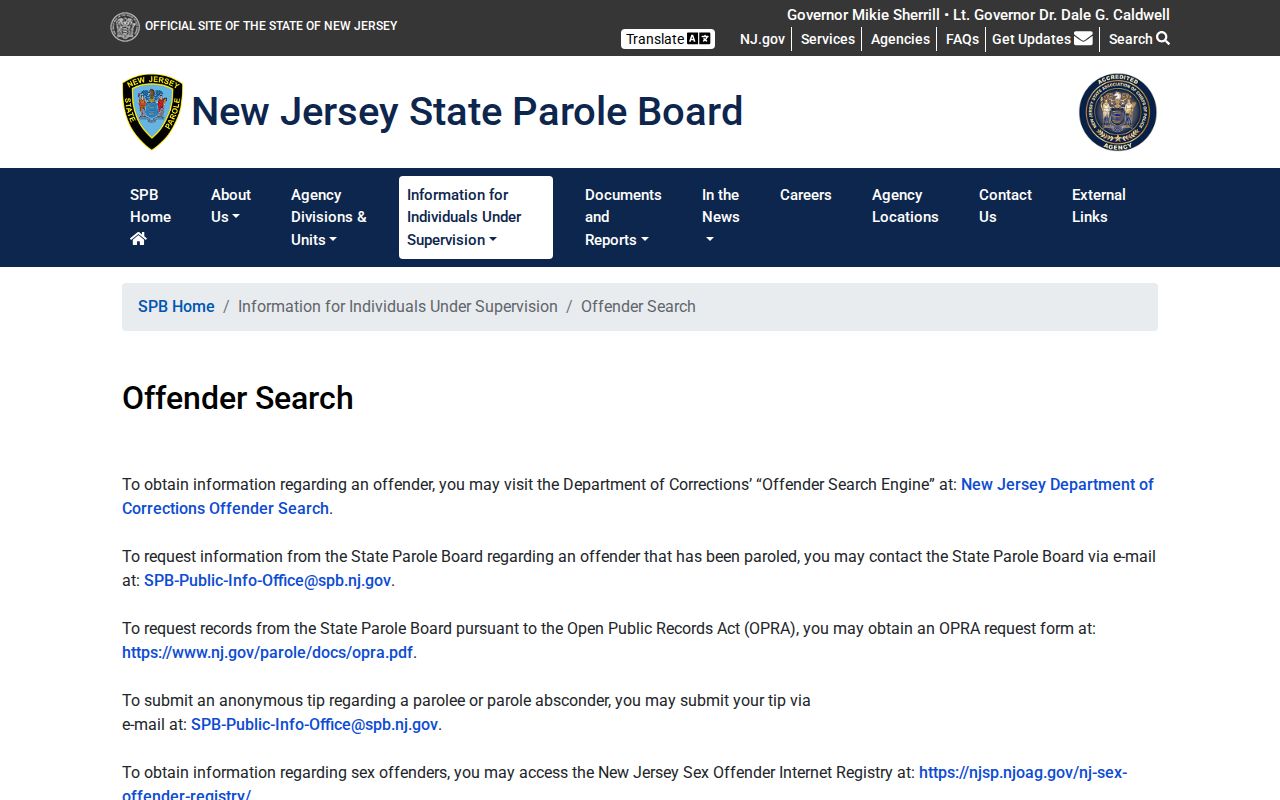
The State Parole Board offender-search guidance shows the official route for offender and parole information.
Note: Eligibility starts review; it is not a release order, final decision, or confirmed date out of custody.
Bergen County Supervision Violations
Supervision conditions come from the responsible Board or court. A violation may prompt added action, a hearing, a warrant, or a new custody episode. An absconder is a person alleged to have stopped reporting or otherwise left supervision without authorization. That label does not mean supervision ended. It can mean the opposite: legal control continues and a warrant may permit return to custody.
The Bergen County Sheriff Warrant Unit serves Superior Court bench warrants and related process, but the Sheriff material reviewed does not provide a safe, complete public list that proves parole status. Confirm a parole warrant with the State Parole Board or law enforcement. The Board lists a fugitive tip line at 1-800-668-7025 for relevant information. Immediate danger belongs with emergency services, not a records request.
New Jersey VINE can report a custody change for a person in a participating county jail or state correctional facility. It does not track ordinary probation reporting and does not prove that parole was discharged. A transfer alert still means the destination must be checked. Each event should be read in the system that created it.
Bergen County Community Release Control
Bergen’s Community Release Programs make the line between a jail bed and full discharge especially important. The Sheriff describes a 65-bed male Community Release Center as well as work release, home custody, Family Care Release, vocational training, State Work Release, the Sheriff’s Labor Assistance Program, outside inmate labor, juvenile electronic monitoring, and bail enhancement responsibilities.
Movement into one of these programs can expand access to work, home, or family while custody or court control remains. “Community release” in a program name therefore cannot be treated as final sentence discharge. Program officers may supervise work details, conduct home-related inquiries, manage monitoring equipment, report violations, and notify the court. A violation can lead to a bench-warrant request or a return to jail.
For a Bergen County participant, ask BCSO for the custody-event record and the court for the controlling order. Then determine whether parole or probation also applies. The program record answers where and how the person was managed. A later discharge record answers when that structured control truly ended.
Bergen County Supervision Discharge
Release from a jail or prison and discharge from supervision are separate milestones. Parole can begin when imprisonment ends. Probation may follow jail time or may be imposed without a prison stay. In either case, the final proof is a record from the authority that supervised the person, not a blank jail search.
For parole, request publicly releasable confirmation from the State Parole Board. For probation, obtain the latest Bergen judgment through the Criminal Records Room, order, or authorized Probation Division record. If the record shows a violation, revocation, or new sentence, rebuild the timeline from that event rather than assuming the original supervision term ran without interruption.
No official public person-level database of New Jersey parole decisions was found in the research. Eligibility notices are not decisions, and the Board’s public-meetings calendar is not a calendar of individual hearings. For a named person, the public-information office or a focused Board OPRA request is the documented fallback. Written decisions go to the person under Board procedures, while administrative appeals route through the Legal Support Unit.
Public access can also narrow. Expungement under New Jersey law removes qualifying matters from ordinary public access after the required process and order. Juvenile, victim, medical, security, and personal information may be restricted or redacted. A lawful redaction does not prove no supervision existed. It shows that the public record has limits.