
Juvenile Center Release Destinations
The Bergen County Department of Human Services, Division of Family Guidance operates the secure juvenile detention function in Teterboro. The facility serves youth accused or found delinquent while they await court action. That role is distinct from BCCRC, the adult jail operated by the Sheriff's Office. Adult release terminology, adult lookup steps, and adult OPRA assumptions should not be copied onto a juvenile case.
A youth may return to family or community under a juvenile court plan. Another outcome may involve movement within juvenile services or to a Juvenile Justice Commission program. Bergen's Family Guidance material also describes a Transition program for youth who completed sentences at specified commission programs and are returning to family and community. Each route involves authorized planning. It is not a public released-person feed.
| Juvenile custody outcome | Meaning | Authorized source |
|---|---|---|
| Return to family | Court-approved community return under the applicable plan | Family Court, counsel, facility, or authorized guardian route |
| Transfer within services | Custody or placement continues elsewhere | Court and responsible juvenile agency |
| JJC program | Juvenile Justice Commission custody or programming may continue | JJC and juvenile court records available to the authorized person |
| Transition monitoring | Structured support after specified program completion | Division of Family Guidance |
| Victim notification | Confidential event notice through the approved process | Victim-witness or registered VINE channel |
Confirm a Juvenile Center Release
No public juvenile name search should be presented as the release route. The adult Bergen Sheriff lookup does not establish a youth's status, and New Jersey's official VINE brochure says juvenile-offender information is unavailable through the public VINE telephone lookup. The right channel depends on the requester's authorized role and the reason for confirmation.
- Use the youth's case or placement details only within an authorized family, counsel, court, agency, or victim-witness relationship.
- Contact the Juvenile Detention Center or Division of Family Guidance for routing, without requesting a public roster.
- Ask counsel or Family Court for the order that controls release, placement, transfer, or return to family.
- If the youth moved to another juvenile program, follow the responsible agency rather than describing the move as community release.
- A registered victim should use the victim-witness or VINE notification route assigned to the case.
- Keep identity, location, family, and case details out of public notes and unrelated searches.
The general Bergen County custody-source overview can help distinguish adult county, state, federal, medical, and juvenile systems, but its adult lookup steps do not override juvenile confidentiality.
Juvenile Release Contact Route
The county directory identifies the Juvenile Detention Center in Teterboro and provides its public telephone number. That number is an access and routing point, not an invitation to obtain a list of youths or confidential case facts. State the caller's authorized relationship and ask which court, counsel, agency, or victim-witness office can address the specific request.
Bergen County Juvenile Detention Center
200 North Street
Teterboro, NJ 07608
201-336-3900
Operator: Bergen County Department of Human Services
Division: Division of Family Guidance
Case authority: Appropriate Family Court and juvenile agency
An authorized person seeking a court order should use the Family Court or counsel route. A person entitled to case services can ask the assigned agency about placement and transition planning. A victim seeking notice should contact the proper victim-witness office or use the registration process offered for that case. These routes confirm a lawful event while respecting the limits on public disclosure.
Note: The facility phone can route an authorized inquiry, but staff may be unable to confirm a youth's identity or status publicly.
Juvenile Center Custody Role
The center is a secure juvenile facility for minors awaiting court action, including youth accused or found delinquent under the juvenile system. The Bergen County directory identifies the facility and contact details, while an official PREA audit corroborates the secure detention site. Juvenile detention is neither adult pretrial incarceration nor an NJDOC state-prison commitment. The legal process, responsible department, access rules, terminology, and transition channels are different.
The distinction prevents several common errors. A child should not be called an adult inmate. A delinquency matter should not be treated as an adult criminal conviction. Absence from an adult roster says nothing about juvenile release. Adult VINE public telephone search steps do not apply. Public-record requests cannot be used to bypass the confidentiality that protects youth and juvenile proceedings.
- Juvenile detention
- Secure custody for a youth under the juvenile court system.
- Placement
- A court or agency-directed setting that may continue legal control.
- Transition
- Structured monitoring and support as a youth returns to family and community.
- Authorized contact
- A person or office permitted to receive case-specific information.
Juvenile Release VINE Limits
New Jersey VINE is widely used for custody notifications, but its juvenile boundary must be stated plainly. The official state brochure says juvenile-offender information cannot be obtained through the public telephone lookup. It also describes automatic release calls for registered victims. Those two facts are consistent: the public cannot browse a juvenile record, while an approved victim-notification process can still deliver an event notice.
A registered notification supports awareness of a custody change. It does not turn the juvenile case into a public record, explain the entire Family Court plan, or authorize disclosure to others. If a notice describes transfer, custody may continue in a different placement. If it describes release, the youth may still be subject to a court plan, transition monitoring, or another lawful condition. The responsible court or agency supplies the context.
The official New Jersey VINE brochure documents both the public juvenile-search restriction and the victim-notification route. Use the live victim-witness instructions assigned to the case because contact methods can change.
Note: A public VINE no-result should never be restated as proof that a Bergen County youth was released.
Juvenile Release Transition Program
Bergen County's Division of Family Guidance describes a Transition program that monitors youth who completed sentences at specified Juvenile Justice Commission programs and supports their return to family and community. This is a locally distinct aftercare route. It should not be labeled adult probation or parole, and it should not be confused with the adult Community Release Center administered through BCCRC.
Transition can involve a planned change from a commission program to community life with county support and monitoring. A youth's actual terms come from the juvenile court and responsible agencies. Public wording should stay broad. It is enough to say that structured support or monitoring may follow program completion. Exact home, school, family, treatment, and schedule information should remain within authorized channels.
The county's Division of Family Guidance overview is the official source for juvenile services and the Transition function.
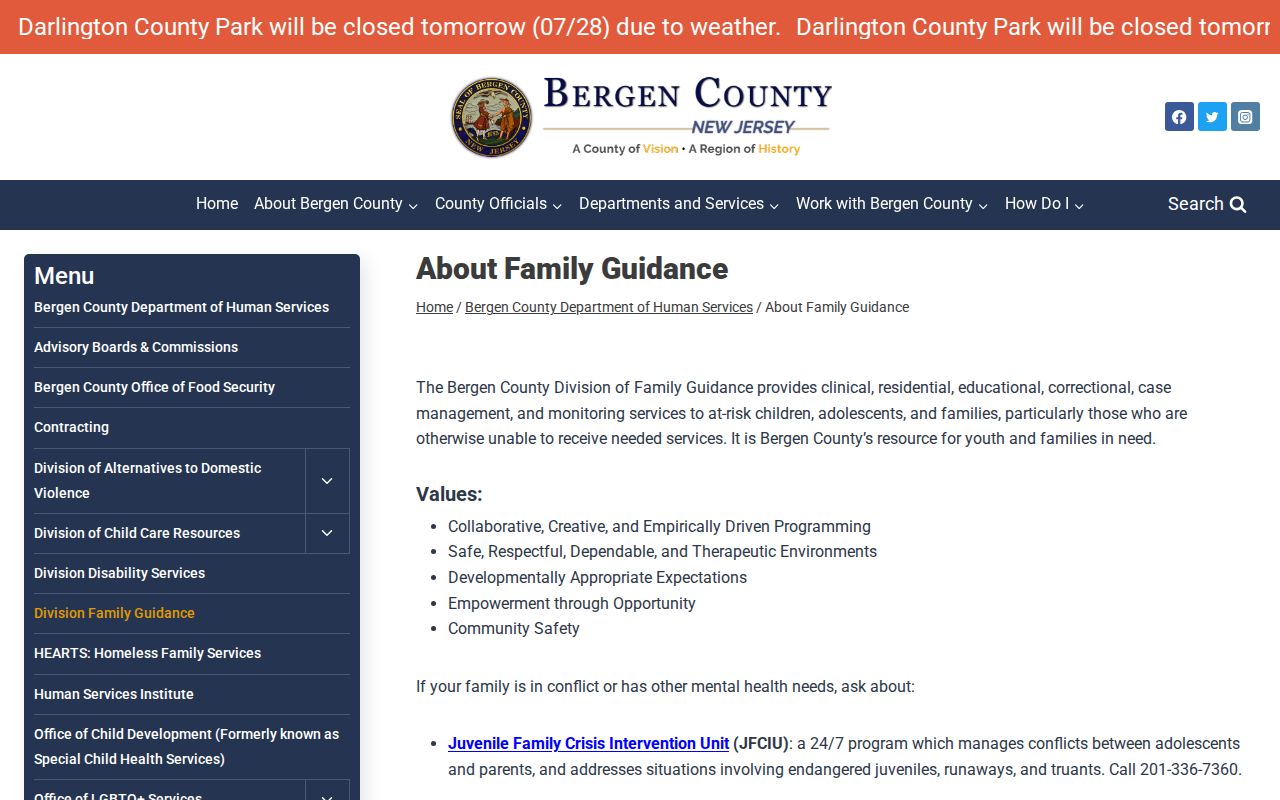
The captured county page supports a service-based transition route rather than an adult-style public release search.
Juvenile Release Record Boundaries
New Jersey public-record law preserves access to many government records, but juvenile identities and case information are materially restricted. A request to a general county or Sheriff custodian does not erase those limits. Records may also contain medical, victim, security, personal, sealed, or other protected details. A denial or redaction does not show that no release or transfer occurred. It shows that the requester lacks public access to the protected field or record.
An authorized person should request the narrow document needed from the office that owns it. Family Court holds the controlling order. The facility or Department of Human Services maintains its operational records. The Juvenile Justice Commission maintains records from its own custody or programs. A victim-witness office manages case-specific notice rights. Asking the right custodian avoids mixing the legal authority with the physical placement record.
| Question | Proper channel |
|---|---|
| What did the court order? | Family Court or counsel |
| Where should an authorized family member call? | Facility or assigned Family Guidance contact |
| Did JJC placement continue? | Juvenile Justice Commission and court |
| How does a registered victim receive notice? | Assigned victim-witness or VINE registration route |
| Can the public search a youth by name? | No public roster route is supported by the research |
Juvenile Release Language and Safety
Use precise, limited language when confirming a juvenile event. “Returned to family under a court plan” is more accurate than “freed” when the authorized record supports a planned return. “Transferred to another juvenile placement” makes clear that custody or control continued. “Completed a specified program and entered Transition monitoring” describes the county service without exposing a home, school, or private schedule.
Do not publish the youth's name, date of birth, photograph, home address, family details, school, case identifier, or destination merely because those facts helped an authorized person verify the record. Never attempt to reconstruct a sealed or confidential matter from cached pages. The public interest in understanding process can be met by describing the agencies and access boundaries without identifying a child.
If an authorized source and a public-facing system appear to conflict, the juvenile court and record-owning agency control their own records. Preserve the date of the inquiry and ask that office to review the discrepancy. Third-party pages and search snippets cannot correct the Family Court, county department, or commission record.
The adult BCCRC facility page is separate and should be used only for an adult county-jail custody episode.
Note: Protecting juvenile identity is part of an accurate release check, not an obstacle to one.