
CRC Release Status and Destinations
The Bergen County Community Release Center is a male residential unit within BCCRC's Community Release Programs. Its name describes a less restrictive placement, not automatic completion of a sentence or case. Movement from the main jail into the CRC can change where a person sleeps, works, or spends approved time. Home custody can place a participant at an approved residence. Work and vocational placements can permit scheduled movement. Yet the Sheriff, court, and program rules can still control the person.
A successful completion may lead to ordinary community life, sometimes with probation, parole, or other court conditions. A violation can be reported to the court and may result in a bench-warrant request or return to jail. The correct status therefore depends on the event being checked. Entry into the program, day-to-day community access, removal, completion, and final discharge are separate record events.
| CRC event | What it means | Record to check |
|---|---|---|
| Placement in CRC | Structured community-release residence | BCCRC custody/program record and court order |
| Home custody | Approved residence under controls | Home-custody status and court authorization |
| Work or training | Approved activity outside the secure unit | Program assignment, not a discharge record |
| Program completion | End of that placement | Completion event plus any later supervision record |
| Violation or removal | Possible return to jail or court action | BCCRC event and newest court entry |
Confirm a CRC Final Release
The CRC has no separately documented public inmate or released-person lookup. Start with the Bergen County Sheriff's custody path because the Work Release Administrator manages the unit within BCCRC's program structure. A person absent from the main jail custody view may have entered the CRC, home custody, another supervised placement, secure medical custody, or a different facility. Absence alone cannot establish final release.
- Identify the person with the exact name, date of birth, booking number, court docket, and approximate program dates.
- Contact BCCRC Jail Records and ask whether the last recorded event was CRC placement, home custody, return, transfer, or discharge.
- Read the controlling court order and later docket entries for the program authority, conditions, completion, violation, or modification.
- Use VINE only for the custody events it reports. A notification may mark a change without explaining continued program control.
- Request the existing BCCRC custody-event and release record, including the event type, date, releasing authority, and destination when maintained.
- Check probation or parole separately if the final record shows community supervision after jail control ends.
The main Bergen County release-search route explains how to reconcile jail, court, VINE, NJDOC, and supervision records when the status remains unclear.
CRC Release Records Contact
The Sheriff does not publish a distinct walk-in CRC records office or a separate public phone-based roster. Route a custody-status inquiry through BCCRC and its Jail Records Unit. Documentary requests go to the Sheriff's Records Bureau. A narrow request should name the program and date range and seek existing fields. Useful fields include admission to the main jail, movement into the CRC or home custody, removal or return, final release or transfer date, event code, releasing authority, and destination.
BCCRC Community Release Programs
Bergen County Corrections and Rehabilitation Center
160 South River Street
Hackensack, NJ 07601
201-336-3500, press 4
Jail Records: 201-336-7903
Sheriff's OPRA email: policerecords@bcsd.us
Records Bureau address: Two Bergen County Plaza, Hackensack, NJ 07601
Public hours: Monday through Friday, 7:30 a.m. to 4:00 p.m., holidays excluded
A written and signed request can ask for electronic records. The Sheriff's current OPRA form supplies the agency route. New Jersey OPRA does not require the custodian to answer questions, calculate a custom status, or create a new report. Ask for the maintained custody-event screen or named record series. A complete ordinary request generally receives a response as soon as possible and no later than seven business days, although clarification, extensions, and statutory exceptions can change the path.
Note: State the precise program and time span because “community release” covers several different Bergen County custody arrangements.
CRC Release Program Scale
The official Community Release Programs material identifies the CRC as a sixty-five-bed male residential unit managed by the Bergen County Work Release Administrator. Assigned officers supervise residents and work details, conduct home-related investigations, install equipment used for home custody, respond to alleged violations, and notify courts. These operational duties show why CRC status is more than an address change. It is a documented supervision and custody arrangement.
The center should not be described as a stand-alone booking jail. The official BCCRC overview identifies the parent jail and its custody role. The main jail handles the custody record, and the court supplies the controlling legal order. Program staff manage placement and compliance. That division of responsibility explains why a full confirmation may require more than one record.
CRC Release Programs and Records
Bergen County's official channel lists several responsibilities under Community Release Programs. Sheriff Work Release and State Work Release permit structured work activity. Home Custody and Family Care Release involve approved settings away from the main jail. Vocational Training supports an authorized activity plan. The Sheriff's Labor Assistance Program and outside inmate labor create other supervised work arrangements. The administrator also handles juvenile electronic monitoring and a Bail Enhancement Program, though those functions do not make every participant a CRC resident.
Each label should be used as the source uses it. “Work release” describes access for work under conditions. “Home custody” means custody continues at an approved location. “Family Care Release” is a named program, not proof that all jail authority ended. SLAP is a structured labor-assistance route. A participant can be physically outside a jail building and still face reporting, equipment, schedule, and court requirements.
- Placement
- A move into an approved program while legal control continues.
- Completion
- The end of a specific program assignment, which may not end every court term.
- Violation
- An alleged breach that staff may report to the court.
- Bench warrant
- A court-issued warrant that may follow noncompliance or failure to appear.
The official Bergen County community-release page is the source for the program list and administrative role.
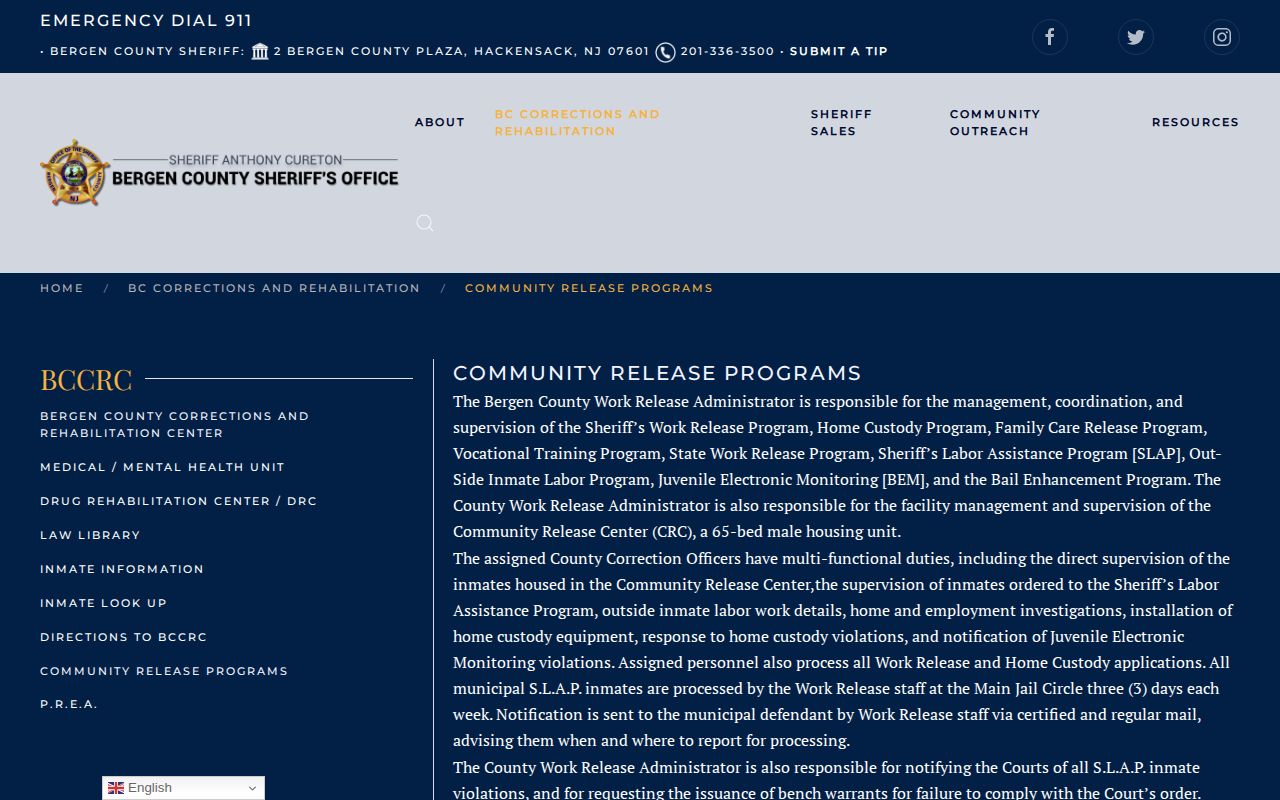
The captured page shows why CRC movement must be classified by program instead of treated as one universal release event.
CRC Court Control After Release
Program staff can supervise, investigate, and report, but the court record explains the legal basis for placement and the consequences of a violation. Search the most recent Bergen criminal case or relevant municipal case with the docket or complaint number. A court entry may show an order, sentence, modification, violation, warrant, or later disposition. The court's record should be read alongside the BCCRC custody event because each answers a different question.
A court order can authorize a change before the jail or program finishes processing it. Conversely, the custody record can show a physical move without explaining every term imposed by the judge. If probation follows the CRC period, probation is a Judiciary supervision function rather than continued residence in the center. If parole follows a state-prison term, the New Jersey State Parole Board is the relevant authority. Neither should be inferred from the word “release” alone.
For a document that is not available through public court tools, use the New Jersey Judiciary records-request process. Do not send a court-record demand to the Sheriff's OPRA custodian.
CRC Release, Return, or Transfer
A final status statement should use the narrowest supported wording. If the record shows placement, say that the person entered the Community Release Center or a named program. If it shows home custody, say that physical custody shifted to an approved home setting under controls. If it shows return, identify BCCRC as the next custodian when the record supports that result. Only use “discharged” when the creating agency or court record actually marks the relevant term complete.
Transfers need the same care. A state-sentenced person may leave Bergen custody for NJDOC. A medical need can produce secure hospital custody. Another county or federal authority can take control. These outcomes differ from a successful CRC completion and community return. The destination field and newest case event usually resolve the distinction.
The sibling BCCRC release-record page gives the adult jail's detailed transfer and records-request paths.
Note: Preserve the exact agency label and event date when comparing records because community access can start before final discharge.